
Trouble in Lithium Land
CATL’s Jianxiawo Mine Restart, Chinese Swing Supply & the Impact on Market Sentiment
The restart of CATL’s Jianxiawo mine has once again shifted sentiment across the lithium sector. While the immediate impact on global supply is measurable, the pronounced market reaction highlights a broader reality: lithium remains one of the most sentiment-sensitive commodity markets in the world, where relatively small changes in supply expectations can produce outsized moves in producer valuations.
The CATL Jianxiawo Catalyst:
Anatomy of a Market Swing
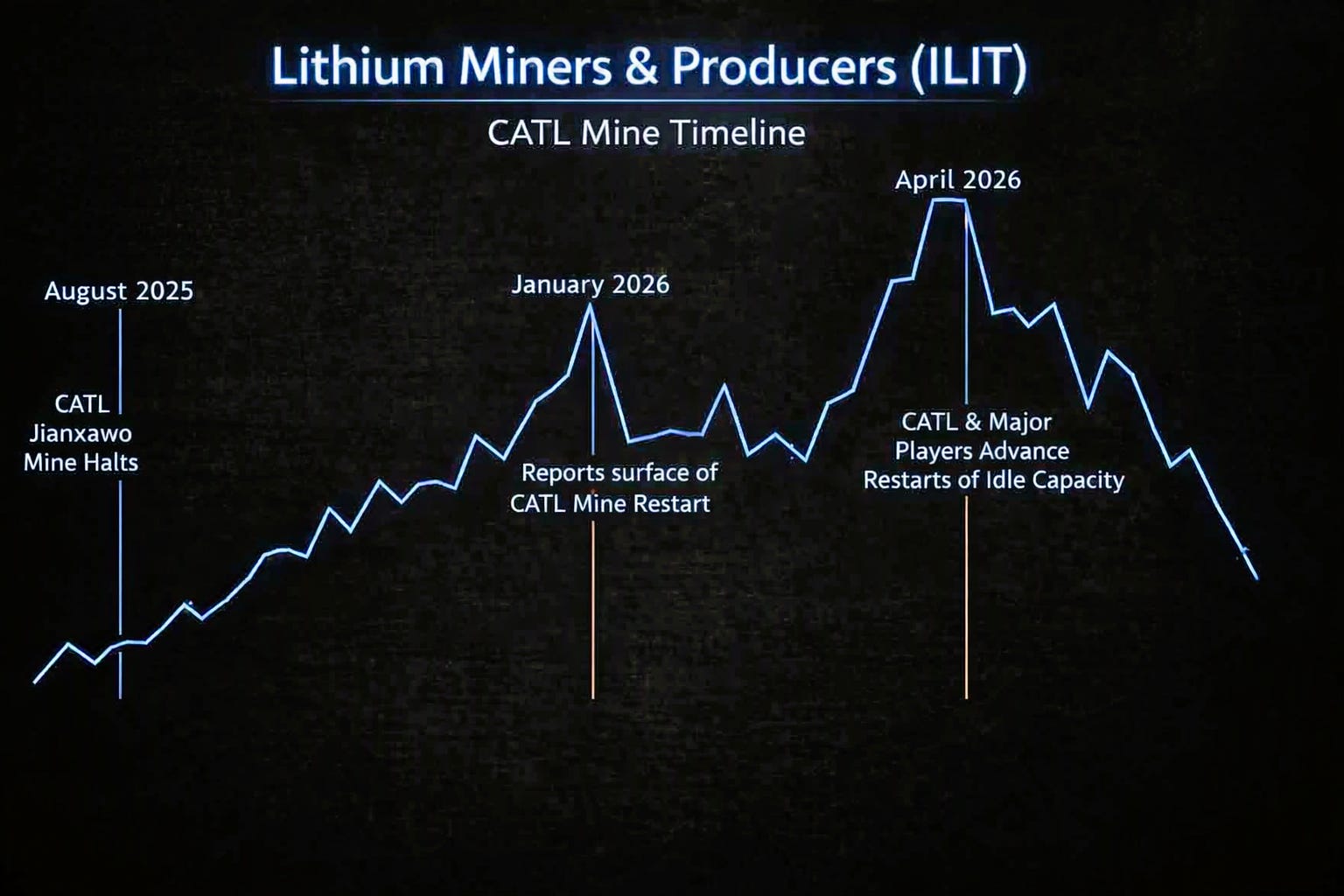
August 2025 CATL’s mining license and key operating permits expired. The company suspended operations at its massive Jianxiawo lithium mine in Yichun, Jiangxi province (3-6% of global output) sending lithium producers up 10-25% in a single sessions. The move forced CATL to tap outside suppliers to source lithium ore for its battery production.
As 2025 came to an end, however, rumours of the mine’s restart began to circulate and sentiment began to shift. After the news broke in January, producer valuations began breaking down. The price of lithium, and producers spiked in March-May (2025) due to a combination of China slashing export rebates and Zimbabwe announcing a raw lithium export ban.
That rally was short lived, however, as CATL advanced it’s Jianxiawo Mine restart in April. By late June 2026, CATL secured the mines safety production permit, successfully clearing the mine’s final regulatory hurdle. At present the Mine is operational, in ramping phase, scheduled to reach name plate capacity by 2029.
Lithium producers have fallen (in aggregate) over 50% from their April peaks.
Why the Market Overreacted
While significant, the 3-6% decrease, and subsequent increase in supply had an outsized, exaggerated impact on Lithium producers.
In contrast, when analogous supply disruptions occur in copper, the reaction, particularly in producers is more subdued. Major copper disruptions are often absorbed by deep inventories and diversified supply chains. The lithium market, is less structurally mature.
While CATL’s mine restart doesn’t “flood” the market in absolute terms it signals potential return of marginal, flexible Chinese supply. It shifted sentiment from potential tightening to renewed overhang risk, pressuring multiples in a sector where cash flows are highly leveraged to price.
Historical Context & Cyclicality
The Lithium market is defined by the classic, highly volatile commodity boom and bust cycles. Lithium has already completed two classic cycles.
Rapid demand growth drove prices sharply higher, triggering aggressive investment and supply expansion. Oversupply followed, prices collapsed, capital retreated, and the cycle reset.
2017 – The Boom
Global EV sales spiked 63% with over 1 million units sold worldwide. Demand exploded catching supply, and the mining industry off-guard. Major companies and automakers scrambled to lock in multi-year contracts placing upward pressure on spot price.
2018-2020 – The Bust
Lithium experienced a steady decline from its 2017 peak as new supply flooded the market resulting in a cyclical bottom and historical low in 2020.
2022 - The Boom
In this post COVID period, the perfect storm of explosive EV demand (bullwhip effect) and severe supply deficits (COVID/China supply chain disruptions) caused Lithium prices to skyrocket over 1000% from 2020 levels. Closely mirroring 2017, automakers panicked and aggressively built up massive strategic stockpiles, amplifying the price move.
2023-2025 – The Bust
Analogous to 2018, elevated price levels led to a massive wave of excess supply. China asserted its dominance as the predominant swing supplier in the market, extracting lithium from low-grade lepidolite ore. Additionally, demand growth for EVs slowed down significantly, further exacerbating the market imbalance.
Each cycle followed the same pattern: high prices incentivized excessive investment, new supply overwhelmed demand, prices collapsed, and capital retreated. Lithium has repeatedly oscillated between shortage and oversupply rather than settling into equilibrium
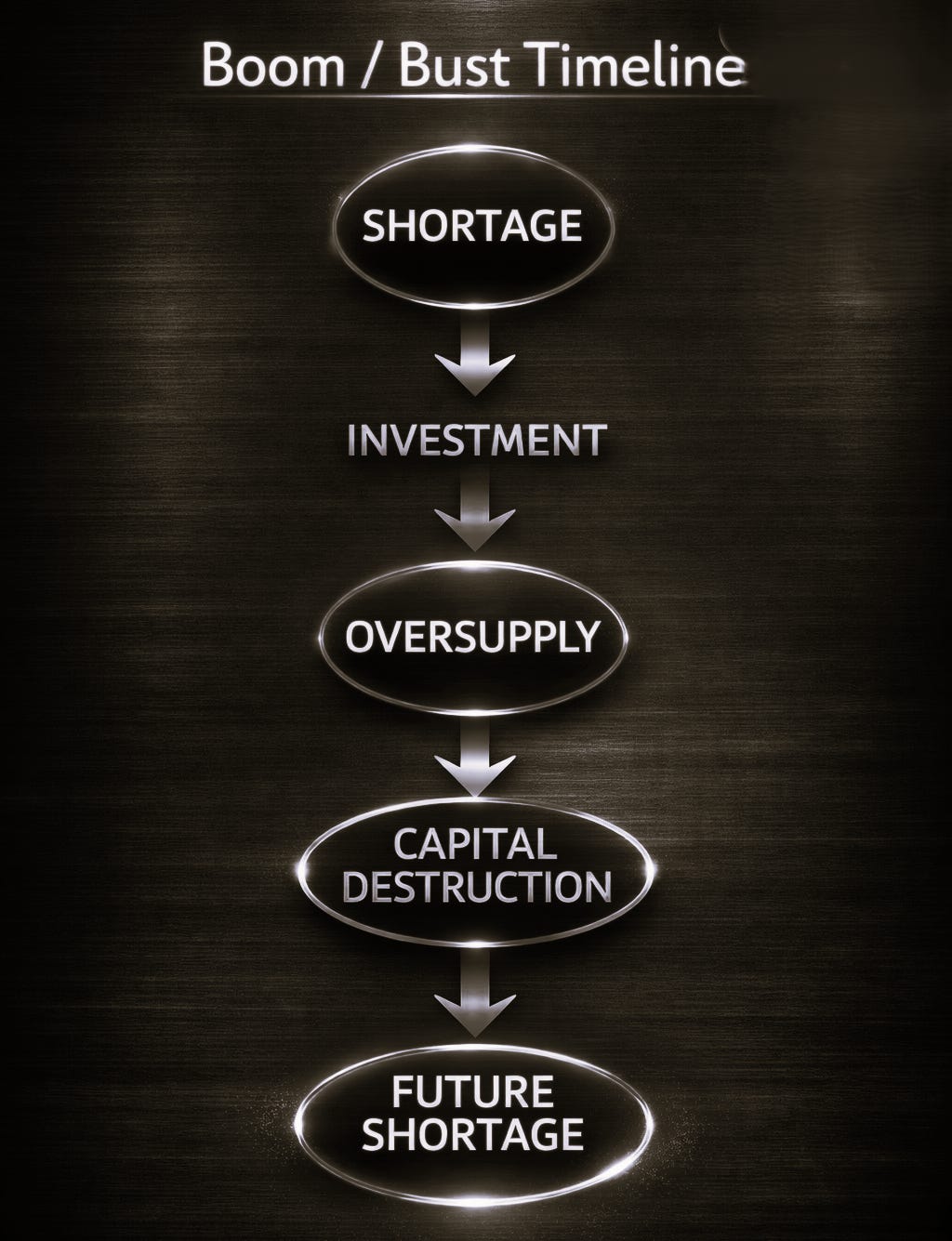
The current environment closely resembles previous downturns, although China’s role as the industry’s swing supplier has become far more pronounced.
The Narrative vs Reality
Demand Narrative
Lithium is the indispensable fuel of the energy transition. Electric vehicle adoption and the proliferation of energy storage systems underpin forecasts of robust demand growth that will outstrip supply resulting in a prolonged bull market.
Long term forecasts by some analysts project global annual consumption to reach 4.6 million tonnes by 2030, an over 300% increase from 2025’s est 1.4 million tonnes annual consumption. These growth projections are underpinned by EV demand (including electric buses and trucks) and battery storage systems (BESS). Non-EV application demand, particularly BESS and its increasing role in AI data centers, grid stabilization, and heavy-duty electrification are increasingly viewed as a underestimated tailwind.
Supply Reality
Lithium supply side has proven remarkably responsive and elastic, particularly through Chinese lepidolite operations acting as classic swing suppliers that ramp when prices rise and flexible enough to idle when margins collapse. This elasticity has repeatedly prolonged oversupply phases and blunted price recoveries
In contrast to hard-rock or brine producers, Chinese Lepidolite operations can restart and ramp in a matter of weeks. The permitted lepidolite-derived lithium capacity is evaluated at 281,000 tonnes annually: the equivalent of approx. 18% of current annual supply.
China’s dominance of global lithium refining/processing (65-75%) allows vertically integrated players to sustain higher-cost mining, maintaining marginal supply output resulting in continued downward pressure on lithium prices and ex-China producers, even at depressed price levels.
Technology Risk: Sodium-Ion
One of the most commonly cited bear cases for lithium is the technological risk the potential sodium-ion batteries pose to lithium.
While sodium does hold attractive characteristics and benefits (abundance, lower costs), it’s lower energy density makes it less competitive in long-range vehicles, commercial transportation, and applications where weight/range remain critical.
Sodium-ion is positioned to complement lithium by serving in applications where costs outweigh energy density (energy storage, low-cost vehicles, two-wheel transportation), not replace it entirely.
The best indicator of the trajectory of the alkali metals is the actions of the battery industries largest players, CATL and BYD. Both companies continue to invest aggressively in lithium mining, refining, and battery production while simultaneously developing sodium-ion technology.
Beyond Lithium: The Big Picture
Lithium’s current market dynamic is not unique.
Lithium is simply one manifestation of a broader trend. Across graphite, rare earths, magnesium, titanium feedstocks, and other strategic materials, Chinese producers have become the marginal price setters through scale, processing dominance, and state-supported industrial policy. The result has been prolonged price weakness, compressed producer margins, and delayed investment across much of the Western mining industry.
The question is whether this represents a permanent feature of the market or a transitional phase.
Increasingly, Western governments are treating critical minerals as strategic infrastructure rather than purely commercial commodities. Export controls, anti-dumping measures, domestic content requirements, strategic procurement, and reshoring initiatives are all aimed at reducing dependence on concentrated Chinese supply chains.
If these policies continue to accelerate, today’s pricing environment may prove less durable than current market expectations imply.
More on this dynamic here
Conclusion
The restart of CATL’s Jianxiawo mine does not fundamentally change lithium’s structural demand trajectory. It does however, reinforce the current state of the market. Sentiment and producer valuations remain highly sensitive to incremental changes in supply.
The current weakness across lithium producers reflects more than near-term oversupply. It reflects a market that continues to assume Chinese supply will remain both unconstrained and economically dominant indefinitely.
While the near-term outlook will likely be characterized by oversupply, volatile pricing, and pressured producer valuations, the probability of structural change is increasing. Prolonged periods of depressed prices discourage investment and delay new projects, eroding the supply growth required to meet future demand. Simultaneously, industrial policy is shifting from prioritizing the lowest-cost supply to favouring resilient and geographically diversified supply chains.
“The cure for low prices is low prices” – Rick rule
The market appears increasingly efficient at pricing today’s surplus yet increasingly uncertain in pricing tomorrow’s constraints. Producer valuations are increasingly disconnected from long-term demand expectations, overemphasizing current market dynamics.
Sustained low prices reduce exploration budgets, delay feasibility studies, and limit project financing. Ultimately, today’s oversupply will reduce tomorrows supply.
The investment question has shifted from who owns the largest resource to who can survive long enough to produce it - Who will remain in position to benefit when demand and supply meet their eventual rebalancing.
The winners will be the companies positioned in the first quartile of the cost curve.
This report is a part of Oculus Research’s ongoing work examining where industrial policy, supply-chain restructuring, and commodity markets diverge from prevailing market expectations.
A forthcoming report explore the entities best positioned to survive the lithium’s transitional phase & capture significant market share of the future lithium market.